Industrial Development in 2026: 3 Things Driving Location Decisions
Industrial recruitment hasn’t slowed down! In recent years, disruption has heavily influenced location strategies due to pandemic shocks, supply chain breakdowns, inflation, interest rate swings, and policy uncertainties. And yet, projects haven’t stopped. They’ve just gotten sharper because site selection has become faster, stricter, and riskier.
Across industries, companies in advanced manufacturing, logistics, and data infrastructure aren’t necessarily looking for the perfect location anymore. They’re looking for locations that reduce risk, preserve flexibility, and give them confidence in their ability to execute. For communities competing for manufacturing, logistics, and data infrastructure investment, this shift matters.
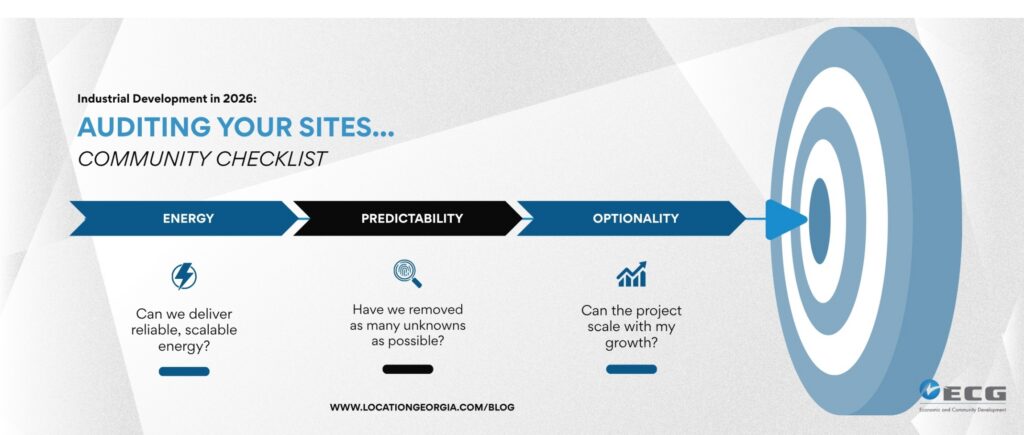
In 2026, that decision-making framework comes down to three things: Power, Predictability, and Optionality
1) Power: From Utility to Gatekeeper
Power used to be a box to check late in the process. Now, it’s often the first question. Between electrification, reshoring, EV supply chains, and the exponential growth of data infrastructure, demand for reliable, scalable power has surged. At the same time, generation timelines, transmission constraints, and interconnection queues have become more complex and less certain.
Companies are evaluating capacity(how much power is available), schedule(when it can be delivered), and scalability(whether the system can grow with them). If those answers aren’t clear, many sites are screened out before a visit is scheduled.
Bottom line: Communities that can answer those questions with clarity and credibility are distinguishing themselves quickly. Those who can’t are often eliminated before the conversation really begins.
What prospects (and their consultants) may ask:
What load can be served at the site today, and what upgrades are required?
What is the realistic in-service date (including utility study, design, and construction)?
If the project doubles in 3–5 years, what does expansion look like (and how long will it take)?
Recommended community actions to take:
Create a clear “power snapshot” for each priority site, available capacity, nearest infrastructure, upgrade needs, estimated timeline)
Establish a consistent process with electric providers
Document who pays for upgrades and what costs are typical
Market only what the site can realistically support based on available capacity and infrastructure
2) Predictability: The New Competitive Advantage
“Shovel-ready” used to be the goal. What companies really want is certainty: fewer unknowns, fewer late-stage surprises, and a development path they can trust.
Environmental issues that surface late (wetlands, endangered species, prior uses, etc.)
Permitting timelines that drift
Site conditions that change project economics (grading, geotechnical issues, off-site improvements, etc)
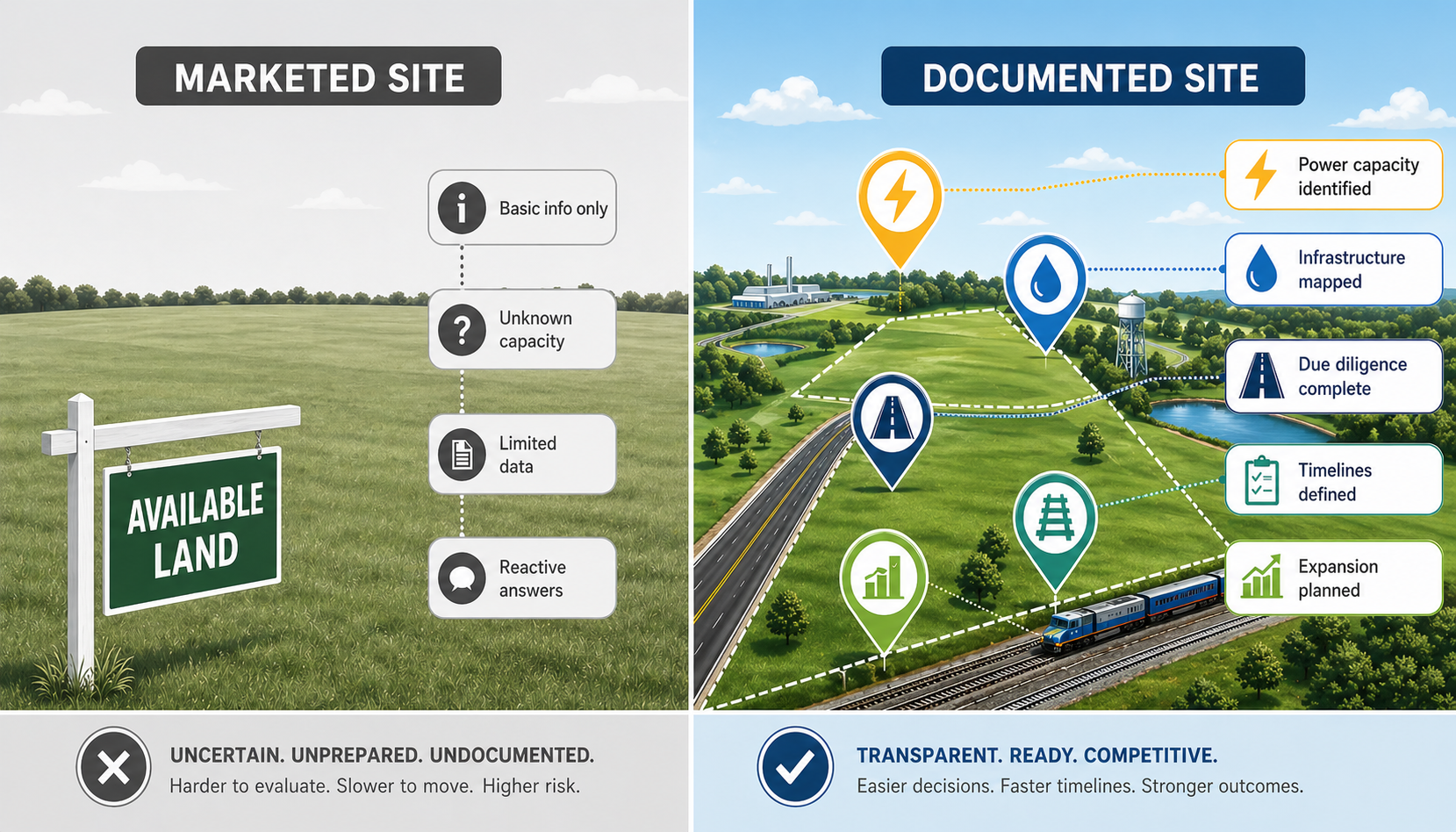
Every unknown is a potential delay. Every delay is a cost. Predictability has become one of the most valuable and underdeveloped assets a community can offer. The best-prepared sites aren’t just “ready.” They are: fully understood, clearly documented, and honestly represented.
Communities that take the time to do real due diligence on utilities, environmental conditions, grading, access, and permitting pathways aren’t just speeding up deals.
They’re de-risking decisions. And right now, de-risking wins.
3) Optionality: Designing for an Uncertain Future
Amid market and policy uncertainty, many companies are building flexibility into their plans, so they can expand, pause, or pivot without relocating. Companies are increasingly structuring projects to preserve options:
Phased investments instead of single, all-in builds (build now, expand later)
Expandable site footprints (extra acreage or adjacent parcels)
Flexible building designs (clear heights, loading, column spacing)
Infrastructure plans that scale (power, water, wastewater, fiber)
Why? Because long-term forecasts are harder to trust, trade policy could shift, and demand could move. Technology could change faster than expected. Labor dynamics could evolve. Energy costs could fluctuate. Optionality gives companies the ability to adapt without starting over.
Communities that WIN don’t just offer a site, they show a credible path to build now and adapt later.
How to use this in your next project:
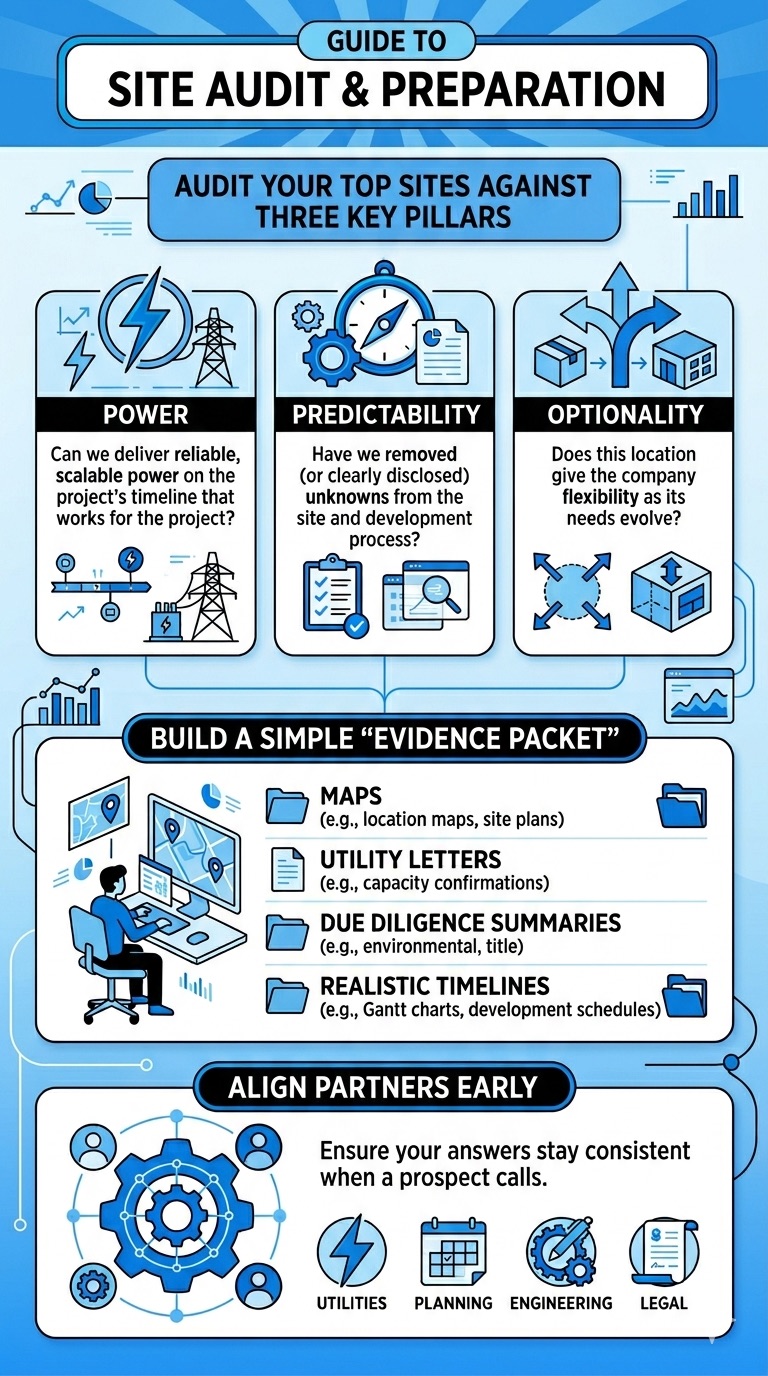
Audit your top sites against Power, Predictability, and Optionality.
Power: Can we deliver reliable, scalable power on the project’s timeline that works for the project?
Predictability: Have we removed (or clearly disclosed) unknowns from the site and development process?
Optionality: Does this location give the company flexibility as its needs evolve??
Build a simple “evidence packet”: maps, utility letters, due diligence summaries, and realistic timelines.
Align partners early (utilities, planning, engineering, legal) so your answers stay consistent when a prospect calls.
What This Means for our Georgia Energy Cities
If any answer is unclear, many prospects will move on, not because your community isn’t interesting, but because it increases execution risk. The good news is that these are controllable. Communities that document utilities, conduct real-site due diligence, and plan for expansion are easier to say “yes” to, especially in uncertain markets.
In a world full of uncertainty, companies aren’t expecting communities to have all the answers.
But they are expecting them to reduce the number of questions. The communities that can do that, by delivering power, predictability, and optionality, will continue to win, regardless of the headlines.