
31 Jul 2026
From Farnborough to Georgia: Why Global Aerospace Growth Matters for the State

The aerospace industry continues to evolve rapidly. New technologies, changing supply chains, growing demand for advanced manufacturing, and increased investment in research and development are creating opportunities worldwide.
Aerospace products were Georgia’s No. 1 export, generating approximately $8.8 billion in economic activity in 2024, according to GDEcD. These conversations are crucial. All the more reason to understand where aerospace and defense companies are expanding, what challenges they are facing, and what they need from future locations.
Georgia Aerospace by the Numbers
Today, more than 120 aerospace products and parts manufacturing employers operate in Georgia, supporting more than 25,000 manufacturing jobs, according to JobsEQ 2025. Georgia has also ranked among the top states for aerospace attractiveness for more than a decade (PwC, 2024).
Georgia’s aerospace industry continues to be one of the state’s strongest economic drivers. Key industry indicators include:
- $8.8 billion in industry economic activity.
- Georgia’s No. 1 export industry.
- Top 5 ranking for aerospace attractiveness.
- Georgia Tech’s aerospace engineering program ranked No. 2 nationally in 2025.
(View The Full Aerospace Defense Brochure Here.)
These strengths continue to attract aerospace manufacturers, suppliers, maintenance operations, research organizations, and technology companies looking for access to talent, infrastructure, and markets.
Five Takeaways from Farnborough International Airshow 2026
Although Farnborough 2026 highlights the latest in aviation and defense technology, our focus was on learning from industry leaders, maintaining connections with the industries driving investment, strengthening relationships with existing employers, and understanding how Georgia’s communities can remain competitive for future opportunities. We caught up with Scott Berta, Manager of Industrial Development, to hear what stood out most.
Aerospace is Georgia’s number one export industry. How does attending a global event like Farnborough help position Georgia to compete for future investment and jobs?
Scott: Attending Farnborough allows us to better understand where the industry is headed before those investment decisions reach our communities. Every conversation helps us identify what manufacturers are looking for in their next location, whether that’s skilled workforce, available industrial sites, reliable utility infrastructure, or access to transportation networks. By bringing those insights home, instead of reacting to industry changes, we’re helping position Georgia’s communities to anticipate them.
What were some of the biggest trends you saw at the airshow, and why should Georgia be paying attention?
Scott: Several themes emerged throughout the week, but perhaps the most significant was the continued growth of defense manufacturing. With increased defense spending, companies are expanding production capacity for military aircraft, autonomous systems, advanced electronics, and aerospace components. Artificial intelligence and advanced manufacturing technologies were also impossible to ignore. Manufacturers are investing heavily in automation, robotics, digital engineering, and smart factories, not to replace people, but to help address workforce shortages while improving productivity and quality.
You mentioned the importance of partnerships. What did you hear from existing aerospace companies about Georgia’s business environment, and how do collaboration and partnerships influence location decisions?
Scott: One message came through consistently: Companies are not simply selecting a site. They are choosing an ecosystem. Georgia has earned an excellent reputation because of the collaborative approach between state agencies, local communities, utilities, educational institutions, and private industry. This coordinated effort helps companies move projects forward more efficiently and gives executives confidence that they’ll have partners long after the ribbon-cutting.
Unmanned drones and advanced aviation technologies were another highlight at Farnborough. What opportunities does this rapidly growing segment create for the State?
Scott: Unmanned aircraft systems are rapidly becoming one of the fastest-growing segments within aerospace and defense. While many think of drones as small consumer products, the industry is increasingly focused on large autonomous aircraft used for defense, cargo logistics, infrastructure inspection, agriculture, emergency response, and advanced air mobility. These platforms require many of the same capabilities as traditional aircraft, including advanced composites, precision machining, avionics, software development, battery technology, electronics manufacturing, and systems integration. Georgia communities can compete for suppliers manufacturing everything from flight control systems and electronic components to composite structures and autonomous technologies.
Some companies exhibiting at Farnborough already have roots in Georgia. Can you mention a few, and how important is it to support and expand relationships with existing industries while also pursuing new opportunities?
Scott: One of the encouraging aspects of Farnborough was seeing so many companies with an existing Georgia presence. Industry leaders such as Gulfstream Aerospace, Lockheed Martin, Boeing, GE Aerospace, RTX, and Safran continue to invest in Georgia because of the state’s skilled workforce, strong infrastructure, and collaborative business environment. Those existing relationships are incredibly valuable. While attracting new companies remains an important part of economic development, much of Georgia’s future growth will come from businesses that are already here. Existing companies expand facilities, introduce new product lines, hire additional employees, and often encourage suppliers and business partners to locate nearby. Supporting those industries through strong local relationships, responsive utilities, workforce development, and community engagement is just as important as recruiting the next major project. Existing industries become ambassadors for Georgia, and their success stories often generate the next wave of investment opportunities.
Opportunities Across Georgia
One of the conversations we often have at events like Farnborough focuses on readiness. Companies want to know where they can grow, how quickly they can move, and whether a community has the infrastructure and workforce needed to support investment. As industries expand, communities with the right assets are well-positioned to compete.
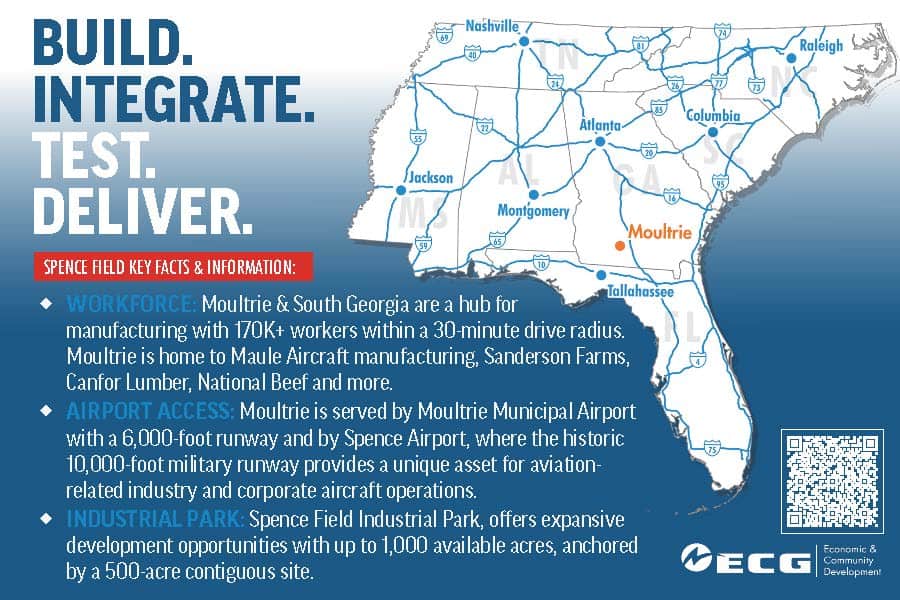
One example is Spence Field Industrial Park in Moultrie, a large-scale industrial site with deep aviation roots. A site that includes approximately 1,000 acres for development, including a 500-acre contiguous site, and sits on a former military air base.
A regional workforce of more than 170,000 workers is located within a 30-minute drive, while nearby transportation assets provide access to interstate corridors, ports, and international markets. The property’s historic 10,000-foot runway remains one of its most unique features for aviation-related operations and corporate aircraft access.
For aerospace companies evaluating future growth, sites like Spence Field demonstrate the types of assets available across Georgia.
Conversations taking place today about future manufacturing, logistics, defense, and research needs, help inform how we market opportunities like these.
Why do we continue having these conversations?
The aerospace industry continues to create opportunities far beyond aircraft manufacturing. Advances in defense, unmanned systems, research and development, mobility technologies, and advanced manufacturing are reshaping how companies evaluate growth and investment.
Whether the discussion is about aerospace manufacturing, emerging technologies, or research and development, the goal remains the same: our team of experts is ready to put its resources and years of local experience to work for you.
Whether you’re visiting Georgia for the first time or expanding an existing operation, our Industrial Development team can help connect you with the data, sites, workforce information, and community resources needed to support your next decision.
To explore more about Site Selection, click here.
Electric Cities of Georgia’s Office of Economic and Community Development provides site selection, retail and industrial development, community development, GIS mapping, research, and marketing services to its 92 energy communities across Georgia. Learn more at https://www.locationgeorgia.com/about-us.